






















Buyer guides
Care home chairs: seat height, armrests and seat depth, with real measurements
What research says about chairs for older people, in plain words, plus the real measurements of 51 solid-wood chairs and armchairs so you can compare before you buy.
Short answer:
- Seat height: older studies say about 430 mm. Residents in a newer study preferred higher seats, because standing up is easier.
- Armrests: must be there. They help most when they sit about 250 mm above the seat and reach the front edge of the seat.
- Seat depth: many care chairs are too deep. One standard quoted in the research prefers 440 mm.
- No single size fits everyone. Buy more than one seat height for one home.
The research here comes from one main study: Blackler and colleagues, Seating in aged care, 2018 (source 1). They watched residents get in and out of chairs and asked residents, carers and experts what works.
Seat height: a little higher helps
Older studies recommend a seat height of about 430 mm. One study says it should not be higher than 431 mm for older women in care.
The 2018 study found something different in practice. Residents, experts and carers all preferred chairs above the recommended height. The reason is simple: from a higher seat, it is easier to stand up. One resident put it like this: "if it's just that bit higher you can get straight out."
There is a trade-off. A low seat with a reclined back is comfortable for long sitting, but much harder to get out of.
What to do: don't buy one height for the whole home. Short residents need lower seats, tall residents and residents who struggle to stand need higher ones.
Armrests: high, and to the front
Residents use armrests to lower themselves into a chair and to push themselves up. The study says armrests must be provided.
What the research says works best:
- Armrests about 250 mm above the seat.
- Armrests that reach the front edge of the seat, so the hands are where the push happens.
- Slim armrests, because they are easier to grip.
Seat depth: not too deep
Deep seats are one of the most common problems. A resident who sits back cannot reach the floor with their feet. A resident who sits forward cannot reach the backrest. "So many arm chairs have deep seats so you're right in the back," said one resident.
The study asks makers to reduce seat depth in most care chairs. It quotes an Australian standard for fixed-height chairs: a depth range of 380 to 480 mm, with 440 mm preferred.
Our 51 care models in numbers
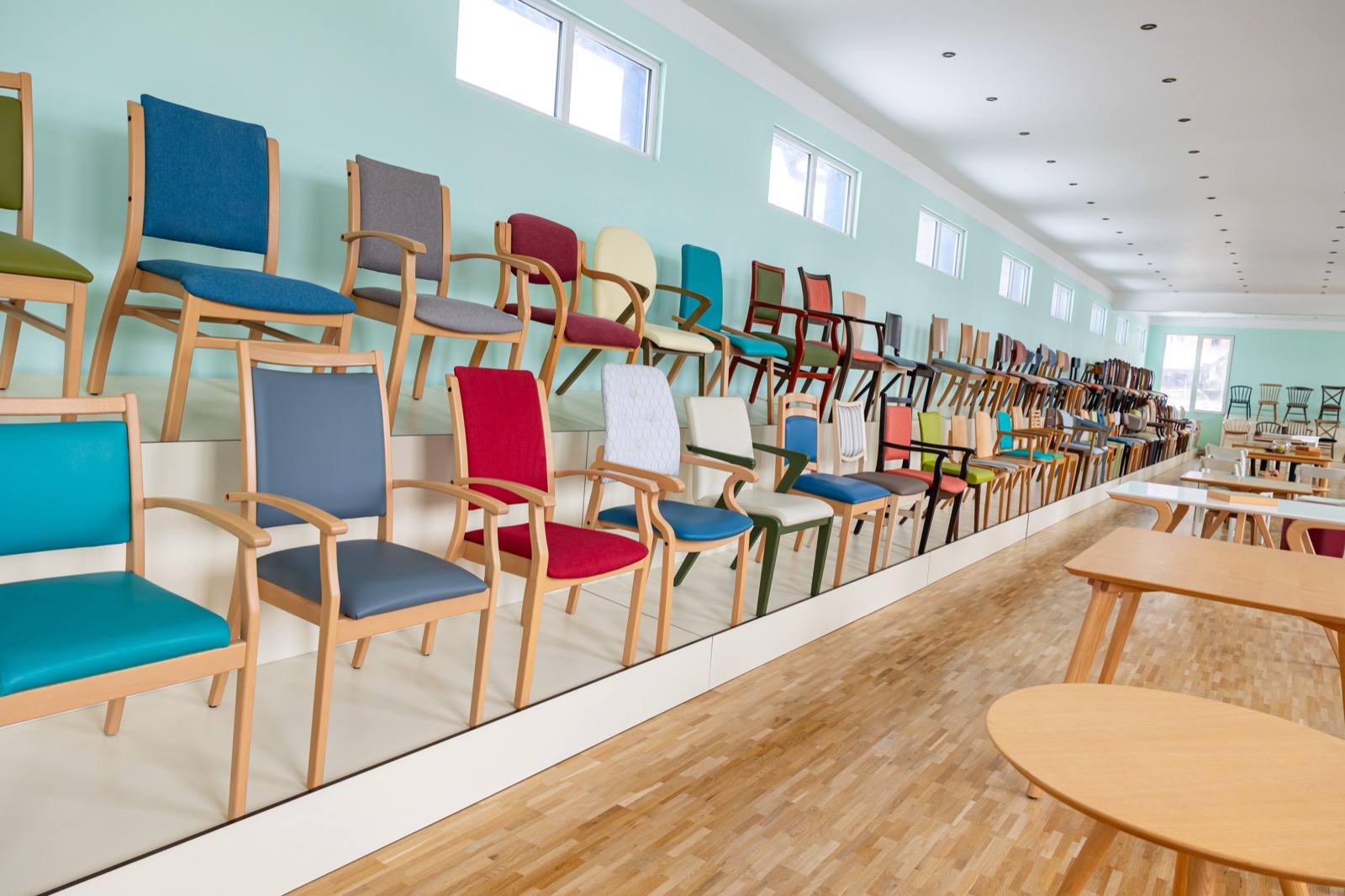
We measured every chair and armchair in the RikoStyle healthcare range: 34 armchairs and 17 chairs (source 2). The full table, model by model, is on our care homes page.
| Range | Usually | |
|---|---|---|
| Seat height | 430–520 mm | 480 mm |
| Seat depth | 430–540 mm | 460 mm |
| Arm height above seat | 150–250 mm | 180 mm |
"Usually" is the median: half the models are below, half above. Arm height above seat is the published arm height minus the seat height. Upholstery compresses when someone sits, so check a sample.
What this tells a buyer:
- Most of our seats are on the higher side. 36 of 51 models have a seat of 480 mm or more. Only 5 are at 450 mm or below.
- Few seats are shallow. 15 models have a seat depth of 450 mm or less. Six are at 440 mm or less.
- Arm height varies. The highest arms above the seat are on the Plaza tub chair (250 mm) and the Mariana tub chair (240 mm).
- If you want a higher seat and a shallower depth together, look at models like the Carmen armchair (seat 510 mm, depth 440 mm), the Fortuna 5 armchair (490 mm, 440 mm) or the Angela tub chair (480 mm, 440 mm).
A buyer's checklist
- Ask for every measurement: seat height, seat depth, arm height, and where each one is measured.
- Sit residents in a sample before ordering. Watch them stand up.
- Check the armrests reach the front of the seat. A photo from the side tells you.
- Mix seat heights in one home.
- Ask which fire level your building needs before you choose fabric. Our fire rules guide explains the UK and French rules.
- For residents with special needs, ask an occupational therapist. A standard chair may not be right.
Sources
- Blackler A., Brophy C., O'Reilly M., Chamorro-Koc M. Seating in aged care: Physical fit, independence and comfort. SAGE Open Medicine, 2018: https://pmc.ncbi.nlm.nih.gov/articles/PMC5758957/
- Dimensions as published on each model's page on rikostyle.com, November 2026.