

















Buyer guides
10 questions to ask a chair manufacturer before your first order
A practical checklist for distributors and contract buyers: testing, fire reports, EUDR, MOQ, lead times, packing and claims, before you order wooden chairs from a factory.
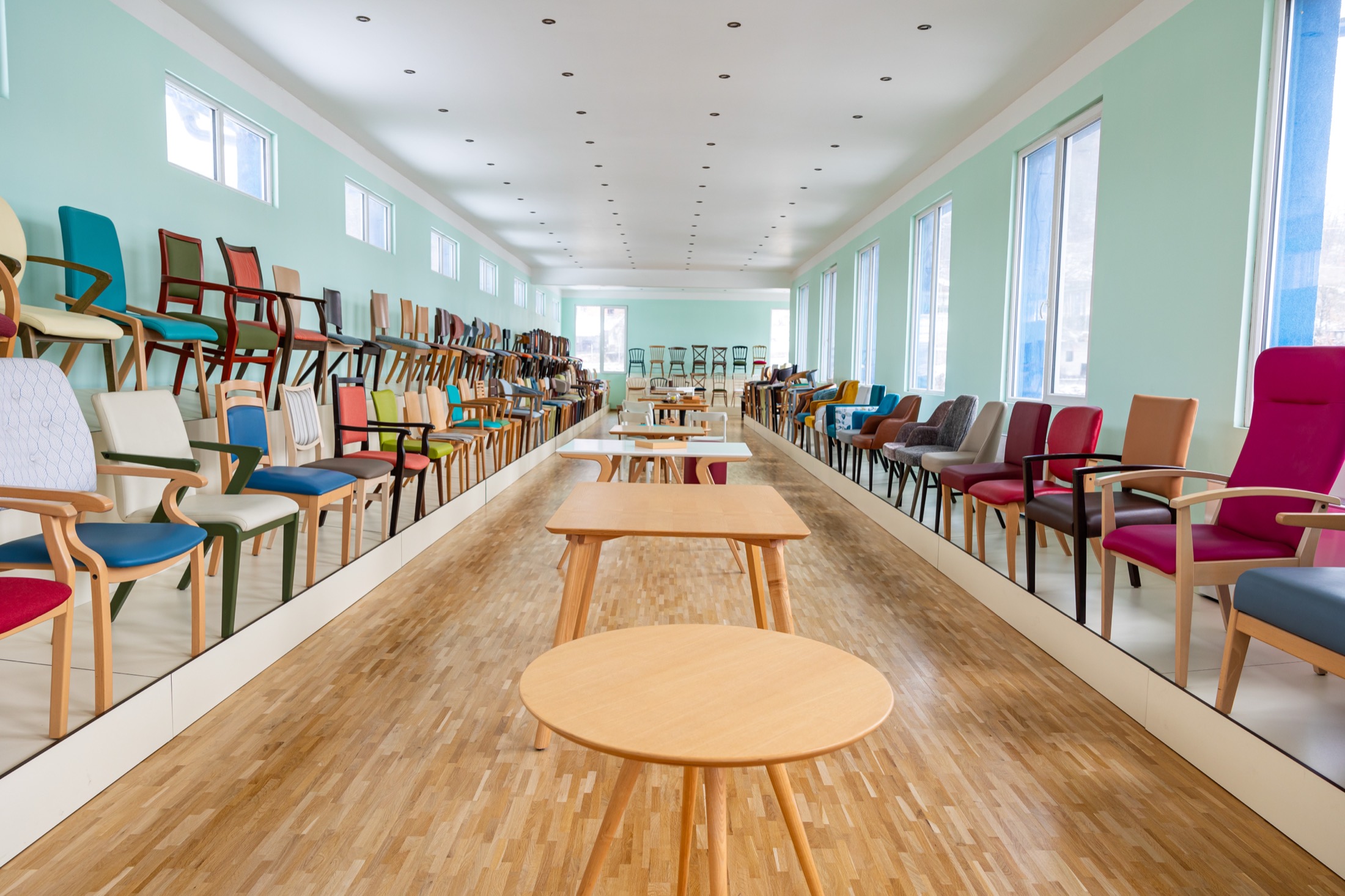
Short answer: before a first order from a furniture factory, get clear, written answers on these ten points:
- who actually makes the product;
- the materials;
- strength test reports;
- fire-safety reports for your market;
- timber traceability under the EU Deforestation Regulation;
- minimum order quantities;
- lead times;
- customisation limits;
- packing and delivery terms;
- the claims procedure.
A good supplier answers in writing, with documents. A risky one answers with adjectives.
This guide is for people who buy chairs and tables from factories: distributors, importers and contract (HoReCa) suppliers. We are a factory ourselves. These are the questions we think you should ask us, and every other factory. Our own answers are at the end.
1. Do you make the product yourself, or source it?
Some "manufacturers" are trading companies. Others make the frames in-house but buy in upholstery or table tops. Neither is wrong, but you need to know who controls quality and lead time.
- Good answer: a clear description of what is made in-house (frame, finishing, upholstery) and what is bought in. They offer a factory visit or a live video walk-through.
- Red flag: no address you can visit, and photos that also appear on other suppliers' websites.
2. What is it made of, exactly?
"Solid wood" can describe the whole chair or only the visible parts. Ask:
- Species. Beech and oak are the usual hardwoods for commercial chairs.
- Every part. Is each component solid wood, or are there plywood, MDF or veneered parts? For tables, ask about the top separately: solid wood, veneer and melamine tops behave very differently in a restaurant.
- Drying. How is the timber dried, and how is moisture content checked before machining? Badly dried wood is a common cause of loose joints after a few months in a heated room.
3. Which strength and durability tests do your models have?
In Europe, the reference for chairs used in restaurants, hotels and other commercial settings is EN 16139 (current edition 2025). It sets requirements for non-domestic seating:
- Level 1 for general use, such as restaurants, cafés and offices.
- Level 2 for severe use, such as night-clubs and transport terminals.
The test methods are in EN 1728. For tables, the equivalent requirement standard is EN 15372.
- Ask for: a test report naming the lab, the date, the exact model and the level. A certificate for "our chairs" in general is not the same thing.
- Good answer: reports for the models you plan to stock. Or an honest "this model has not been tested", plus a quote for testing it.
- Red flag: a test report for a different model, or for a domestic standard.
4. Which fire-safety reports cover the upholstery in my market?
Fire rules for upholstered seating are set nationally and depend on the type of venue:
-
EN 1021-1 and EN 1021-2 (cigarette and match ignition) are widely used tests.
-
Some countries add stricter national rules for venues open to the public. France is an example.
-
Ask for: the test report for the specific fabric and filling combination, and which national rule it is meant to satisfy.
-
Tip: if you supply your own fabric, the fire documentation is usually your responsibility. Agree this in writing.
5. Can you document where the timber comes from?
The EU Deforestation Regulation (EUDR) covers wood products, including furniture. After the latest amendment, it applies from 30 December 2026 to large and medium operators. Some micro and small operators have until 30 June 2027.
Under the regulation, the business that first places a product on the EU market must show that the wood is deforestation-free and legally harvested. That includes geolocation of the harvest area.
- Ask for: the information the factory can pass on for your due-diligence statement, and from which date.
- Note: FSC or PEFC certification helps, but it does not replace EUDR due diligence.
6. What is the minimum order, per model and per finish?
A low headline MOQ can hide a higher minimum per colour or fabric. Ask:
- Is the minimum counted per order, per model, or per model and finish?
- Can one order mix models and colours?
- Is there a separate minimum for custom colours or for the customer's own fabric?
7. What are the lead times for samples and for production, and what changes them?
Ask for both numbers, plus what moves them:
- the season;
- fabric availability;
- custom finishes;
- order size.
Ask how you will be told about a delay, and when. A supplier that commits to a date and warns you early is worth more than one that quotes a shorter time.
8. Which customisations are standard, and which need approval?
Common options:
- frame colour;
- upholstery;
- customer's own material (COM);
- seat or table height;
- a logo or symbol cut into the backrest.
For each option you want, check three things:
- Is it available on that model?
- Does it change the price, the MOQ or the lead time?
- Will you get a sample or a drawing to approve before production?
9. How is it packed and delivered?
These points change the landed cost per chair more than most buyers expect:
- Assembly: are chairs shipped assembled or flat-packed?
- Stacking: do the stacking models stack in transport, and how many fit on a pallet or in a truck?
- Delivery terms: which Incoterms rule applies (for example EXW, FCA or DAP), and who books and insures the transport?
- Within the EU: there are no customs duties between member states, and VAT is usually handled under the intra-community rules when both companies have valid EU VAT numbers. Check the details with your accountant.
- Buying from Bulgaria: the country has been fully in the Schengen area since January 2025, so there are no routine checks on persons at its land borders with other Schengen countries. It has used the euro since January 2026, so euro-area buyers carry no exchange-rate risk.
10. What happens if something arrives damaged, or fails after a year?
Before the first order, agree in writing:
- Damage on arrival: the time limit for reporting it, with photos.
- Later defects: the warranty period and what it covers.
- Spare parts: whether you can get them, such as seat pads or glides.
- Remedy: who pays for return transport, or whether the supplier sends a replacement.
A clear claims procedure is one of the best signs of a supplier that has worked with distributors before.
How to compare the answers
| Question | Strong answer | Weak answer |
|---|---|---|
| Who makes it | Visit or live video, clear in-house scope | "We have partners" |
| Materials | Species and construction per part | "Premium wood" |
| Testing | Report per model, lab and level | "Our chairs are certified" |
| Fire | Report per fabric and filling | "Fire-resistant fabric" |
| EUDR | Named data and a start date | "Not our responsibility" |
| MOQ / lead time | Per model and finish, in writing | A single headline number |
| Claims | Written procedure with time limits | "We will sort it out" |
Copy-paste checklist for your first enquiry
1. Which parts of this model do you make in-house?
2. Wood species and construction of every part (incl. table top)?
3. EN 16139 / EN 15372 test report for this model: lab, date, level?
4. Fire test report for this fabric + filling, for [country/venue type]?
5. What EUDR due-diligence information can you provide, from when?
6. MOQ per order / per model / per finish? Can models be mixed?
7. Sample lead time and production lead time? What changes them?
8. Which customisations are available on this model, at what cost/MOQ?
9. Assembled or flat-pack? Units per pallet/truck? Incoterms?
10. Claims procedure, warranty and spare parts?
Our answers
We asked ourselves the same ten questions:
| Question | RikoStyle |
|---|---|
| 1. Who makes it | We do, in our own factory in Troyan, Bulgaria, since 1992. See the factory |
| 2. Materials | Solid beech, many models also in solid oak. Table tops in solid wood, veneer or melamine, by model |
| 3. Test reports | Ask us which test reports exist for the model you want |
| 4. Fire safety | Fabrics and foams that comply with European and UK fire-retardant regulations. Certificates on request |
| 5. Timber origin | Our timber comes from replanted sources. Ask us what EUDR information we can provide for your order |
| 6–7. MOQ and lead time | In writing, in your quote |
| 8. Customisation | Frame colours and upholstery per model. Logo cut-out on 15 models |
| 9. Packing and delivery | Delivery terms in your quote |
| 10. Claims | Warranty terms in your quote |
How an order works with us, step by step: For distributors.
About RikoStyle
RikoStyle is a manufacturer of solid-wood chairs and tables based in Troyan, Bulgaria, supplying hotels, restaurants, event venues and public spaces. Browse the ranges:
Compare all models with their dimensions, or download the product list in Excel with every model, its dimensions and its options. Then send us your ten questions too: office@rikostyle.eu.